



Steering Wheel Shakes at High Highway Speeds Troubleshooting Guide
Feeling your car shake while driving can be very unsettling. It makes you worry about your safety on the road. Your car is speaking to you, and these shakes mean it needs your attention.
We’ve been working on cars for nearly thirty years. We know most problems can be fixed if you find the cause. Ignoring these signs can make driving dangerous. So, it’s important to fix them quickly.
Just like when a car won’t start, finding the problem is key. This way, you can drive safely again.
Safety is our main concern as we guide you. By following our steps, you can find and fix the issue. This will make your car run smoothly again.
Key Takeaways
- Vibrations are critical warning signs that demand immediate inspection.
- Most steering issues stem from tire balance or suspension wear.
- Early detection prevents costly repairs and ensures driver safety.
- A systematic diagnostic approach simplifies complex mechanical problems.
- Maintaining your vehicle preserves its long-term performance and value.
Understanding the Causes of Steering Wheel Shaking
Finding out why your steering wheel is vibrating is key to driving safely again. If your car shakes at high speeds, it might need a quick fix. Usually, the problem lies with your tires, suspension, and brakes working together.
Common Reasons for Steering Wheel Shakes
Drivers often face steering wheel shake for a few reasons. It can be due to an unbalanced wheel or worn-out parts. Ignoring these signs can damage your car’s steering rack or wheel bearings.
Loose tie rods or ball joints can cause wheels to shake. This shaking gets worse as you drive faster. It’s important to check these parts if you notice your car shaking.
The Impact of Wheel Alignment on Shaking
Wheel alignment is vital for a smooth drive. If your wheels are not aligned, they can cause tension in the steering system. This misalignment leads to a vibration that can make your car feel unstable.
Correct alignment ensures your tires touch the road evenly. Misalignment causes steering parts to wear out faster. Keeping your alignment right is good for comfort and your car’s health.
How Tire Conditions Affect Steering Performance
Your tires are the only thing touching the road. Uneven tread or internal damage can make the wheel wobble. This is a common reason for steering wheel shake we see.
Even a little uneven wear can upset the wheel’s balance. Regularly check your tire pressure and tread depth to avoid these problems. Here’s how different front-end issues affect drivers.
| Component | Primary Symptom | Severity Level |
|---|---|---|
| Tires | High-speed vibration | Moderate |
| Brakes | Shaking during braking | High |
| Suspension | Loose steering feel | High |
| Alignment | Vehicle pulling/drifting | Low to Moderate |
How to Diagnose Steering Wheel Shakes
When you notice your steering wheel shaking, start by observing when it happens. If the vibration only shows up at certain speeds, it might mean your wheel and tire are out of balance.
By paying attention to these patterns, you can guess what might be causing the problem. This is important, as it helps you fix issues before they get worse. Following high-mileage cars maintenance tips can also help keep your car running smoothly for a long time.
Checking for Visual Tire Damage
Start by looking at your tires closely. Check for uneven wear, bulges, or deep cuts. These signs can mean your tire is damaged.
Even a small amount of damage can cause big problems at high speeds. If your tires are cupping or wearing unevenly, it’s a sign you need to check your suspension or alignment.
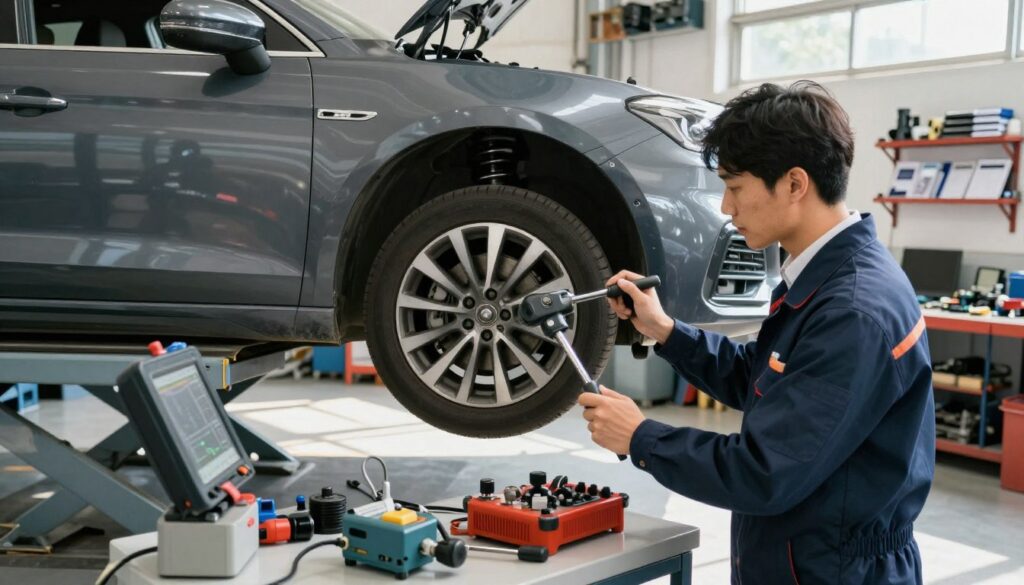
Using a Professional Mechanic for Diagnosis
Not all problems are easy to spot. If you’ve checked your tires and found nothing wrong, it’s time to see a mechanic.
Mechnics have tools like road-force balancers to find hidden problems. They can find issues you can’t see. This way, you fix the real problem, not just the symptoms.
DIY Testing Methods for Steering Wheel Problems
You can do some simple tests at home. First, check your tire pressure. Make sure all tires are at the right pressure.
Then, try rotating your tires. If the vibration stays in the steering wheel, it might be a front-end or wheel problem. Keeping an eye on these signs can save you money and time later.
Importance of Tire Balance and Rotation
When your car shakes at high speeds, it’s often because of tires. About 50–70% of steering issues come from tires. Fixing these problems early helps your car drive smoothly.

How Unbalanced Tires Contribute to Vibration
Tires need to be perfectly balanced to work right. Even a small imbalance can cause big problems at high speeds. The spinning wheel makes these small differences feel like a shake through the steering column.
This shake is more than just annoying. It means your tires aren’t touching the road evenly. If not fixed, it can damage your car’s parts and wear out your tires faster.
- It can wear out suspension parts faster.
- It causes uneven wear on tires, making them last less.
- It also means less grip when you need to stop quickly.
The Role of Regular Tire Rotation
Regular tire rotation is key to preventing these problems. It keeps tires from wearing down unevenly. This stops the tires from getting uneven tread shapes that make your steering wheel shake.
Rotation also lets technicians check each tire for damage or alignment issues. This helps keep your car running well and keeps you safe on the road.
Exploring Brake Issues
If your steering wheel shakes when you brake, it’s likely a rotor problem. Many drivers overlook the importance of the braking system. Brake issues show up as a pulsing feeling in the pedal and steering column.

Signs of Brake Problems Beyond Steering Shaking
Other signs your brakes need attention include a rhythmic pulsing in the brake pedal. This usually means the rotors are uneven. Also, squealing or grinding sounds when stopping mean your brake pads are worn out.
High temperatures can warp rotors, causing them to shake. Ignoring these signs can make stopping in emergencies dangerous.
Understanding Brake Pad Wear and Its Impact
Brake pad wear affects your rotors’ health. Thin pads can cause metal to rub against the rotor, creating grooves and heat spots. This can make your steering unstable.
Incorrect lug nut torque can also warp rotors. Uneven tightening puts uneven pressure on the rotor, causing it to warp early. Checking both pads and rotors is key to fixing shaking steering wheel issues.
Fixing brake problems quickly keeps your vehicle safe. Regular checks can prevent expensive repairs. Keeping your brakes in good shape ensures a smooth drive.
Checking Suspension Components
Let’s take a closer look at the parts that keep your vehicle stable and responsive. These parts act like the cartilage of your vehicle, absorbing road imperfections. When they wear out, you might find yourself troubleshooting steering wheel vibration that’s hard to fix.

Key Suspension Parts to Examine
The suspension system has several key parts to keep your tires on the road. Check your ball joints, tie rods, and control arm bushings for looseness. If they’re loose, your steering might feel off.
Sometimes, mechanical problems make sounds before they cause shaking. If you hear odd noises, look up a guide on identifying engine and chassis sounds. This can help you figure out if it’s a suspension issue or something else. Keeping these parts in good shape is key for fixing troubleshooting steering wheel vibration.
“A vehicle’s suspension is the silent partner in every journey, working tirelessly to translate the chaos of the road into a smooth, controlled experience for the driver.”
Signs of Worn Struts and Shocks
Struts and shocks help dampen the shock from bumps and potholes. When they wear out, your vehicle can’t keep tires in contact with the road. This leads to bouncing and poor steering at high speeds.
Try pushing down on each corner of your vehicle. If it bounces after you stop, your shocks need to be replaced. Fixing these worn parts is a big step in troubleshooting steering wheel vibration and improving your car’s handling.
The Role of Wheel Alignment in Steering Control
Proper wheel alignment is key to safe and smooth driving. It’s often confused with wheel balancing, but they’re different. Balancing deals with weight on the tire, while alignment keeps wheels at the right angle.
If your steering wheel shakes at high speeds, misalignment might be the cause. This can happen over time or suddenly after hitting a pothole or curb.

How Misalignment Affects Driving Safety
When wheels are misaligned, tires don’t touch the road right. This leads to serious safety issues:
- Uneven tire wear means you’ll need new tires sooner.
- Your car might pull to one side, needing constant steering.
- It also uses more fuel, costing you money.
- Handling gets worse, making emergencies riskier.
When to Schedule an Alignment Service
Regular checks can prevent costly repairs. Get an alignment check yearly or if your car drifts. If you hit something hard, get it checked right away.
Keeping your suspension in check makes driving safer. Consistent alignment keeps your car stable and comfortable. Don’t wait for problems to get worse before checking your alignment.
Influence of Driving Habits on Steering Stability
How we drive our cars is just as important as the car itself. Our daily driving habits can wear down parts faster. By changing how we drive, we can reduce stress on our vehicles.

Identifying Bad Driving Practices
Driving aggressively, like speeding up fast and braking hard, harms your car’s suspension and steering. Ignoring small vibrations can turn into big problems. Consistent neglect of these signs often leads to a car shaking at high speeds that’s hard to ignore.
Here are some common bad habits that can wear your car down:
- Frequent, harsh braking that warps rotors and affects steering feedback.
- Driving over potholes or curbs at high speeds, which misaligns the wheels.
- Ignoring unusual noises or subtle shimmies until they become severe.
Maintaining Consistent Speed on Highways
Driving at a steady speed on highways is good for your car’s health. Constantly changing your speed puts uneven pressure on your car. If your engine mounts fail, it can cause vibrations, even when stopped.
“The way a driver treats their vehicle is the single greatest predictor of its long-term mechanical reliability and safety on the highway.”
Many drivers think engine vibrations are steering problems. If your car shakes at high speeds, check if your driving style is the cause. Smooth acceleration and steady speed reduce stress on your car, preventing car shaking at high speeds over time.
Seasonal Factors Affecting Your Steering
Your car’s performance changes with the seasons and weather. While we look at mechanical wear, the environment also plays a big role. Knowing these factors helps us spot highway speed steering wheel problems early.
How Weather Changes Impact Driving Dynamics
Temperature and moisture changes affect how your car handles. Cold weather makes rubber stiffer, while heat can change tire pressure. These changes can hide or show problems in your suspension.
Wet weather with sudden temperature drops is a big risk. Thermal shock happens when you hit a puddle after braking hard. This can warp brake rotors, causing vibrations.
“Proper maintenance is the bridge between a reliable vehicle and a roadside emergency, even when the seasons change.”
Preparing Your Vehicle for Different Conditions
To keep your car stable, adjust your maintenance based on the weather. Taking care of your suspension and tires helps them fight off the elements. Here are key steps to keep your vehicle in great shape:
- Check tire pressure monthly: Air pressure changes with temperature, affecting your grip and handling.
- Inspect brake components: Look for uneven wear or warping after heavy rain or winter driving.
- Lubricate suspension parts: Seasonal moisture can cause rust, so keep joints well-greased to prevent stiffness.
By staying ahead of seasonal changes, you lower the chance of highway speed steering wheel problems on your daily drive. Regular checks keep you safe, no matter the weather. A well-maintained car is always predictable.
Common Myths About Steering Wheel Shakes
Many drivers rely on old myths to fix their car’s shake. They think any shake in the steering column comes from one simple thing. But, troubleshooting steering wheel vibration needs a detailed look to find the real problem.
Debunking Misconceptions About High-Speed Vibration
Some think all high-speed shakes come from unbalanced tires. But, tire balance is just one reason. Drivers often spend on balancing but ignore other issues like suspension or alignment.
Another myth is that steering wheel shakes mean bad tires. But, your tires might be fine, and a loose tie rod or worn-out wheel bearing could be the problem. We suggest checking deeper mechanical wear.
Why Some Symptoms Are Often Misunderstood
Symptoms are often misread because drivers link them to the wrong parts. For example, a vibration when pressing the brake pedal points to brake issues, like warped rotors. Yet, many owners first try rotating their tires.
Knowing these differences is key for fixing steering wheel shakes. By finding the real cause, you avoid unnecessary repairs. Spotting the true reasons for steering wheel shake helps fix your car right, keeping it safe and reliable.
Best Practices for Preventing Future Shakes
Regular care is key to avoiding steering wheel problems. By staying ahead of mechanical failures, your vehicle stays safe and comfy. Learning how to fix shaking steering wheel starts with preventing it.
Regular Vehicle Maintenance Tips
Keeping up with maintenance is your best defense. Regular tire rotation reduces uneven wear, like cupping and feathering. These are common causes of steering wheel shakes. Check your tire pressure monthly for even road contact.
Also, get professional alignment checks every 6,000 miles. If your car pulls to one side, it’s time to see a mechanic. Learn more about why is my car shaking to spot early signs of wear.
What to Monitor After Repairs
After fixing a vibration issue, stay alert. Watch your steering feel on your first few highway drives. If it shakes again, a worn bushing or loose wheel lug might need fixing.
Keep a service history log. It helps track when parts were replaced. This way, you can spot if something is failing too soon. Paying close attention is the best way to stop steering shakes from coming back.
| Maintenance Task | Frequency | Benefit |
|---|---|---|
| Tire Rotation | Every 5,000 Miles | Prevents uneven wear |
| Wheel Alignment | Every 6,000 Miles | Ensures straight tracking |
| Suspension Inspection | Every 12,000 Miles | Detects worn components |
| Tire Pressure Check | Monthly | Maintains optimal handling |
Staying consistent with these steps will make your steering system last longer. Remember, knowing how to fix shaking steering wheel is just the start. The real battle is keeping your car in top shape through careful observation.
When to Seek Professional Help
Your vehicle needs expert care if simple fixes don’t work. A professional steering wheel shakes at high speeds troubleshooting is key. It keeps you safe on the road by fixing hidden problems.
Recognizing When DIY Fixes Aren’t Enough
Go to a certified shop if your car gets worse or makes strange noises. Ignoring these signs can lead to costly repairs. Experts have the tools to find and fix issues that DIY checks might miss.
How to Choose a Reliable Mechanic
Finding the right mechanic is important for your car’s health. Look for places like Grewal’s Automotive in Indianapolis, IN. They do detailed checks on driveline, suspension, and brakes.
A good shop will talk clearly and have a plan to make your drive comfortable. Letting experts handle your car means it gets the care it needs for a smooth ride.
FAQ
Common Reasons for Steering Wheel Shakes
The most common causes of a vibrating steering column are issues with the wheel and tire assembly. Even a small weight difference can cause significant centrifugal force at high speeds. This force makes the wheel hop or wobble, sending a rhythmic shake to our hands.
Worn CV joints or a damaged driveshaft can also cause instability in the front-end geometry.
The Impact of Wheel Alignment on Shaking
Alignment issues usually show up as the vehicle “pulls” to one side. But extreme misalignment can also cause steering instability. If the wheels are not parallel or perpendicular to the ground, the tires “scrub” against the road.
This uneven contact can lead to feathered wear patterns. These patterns eventually cause the steering wheel shakes at high highway speeds that we try to avoid. Proper alignment ensures that the tires work together harmoniously.
How Tire Conditions Affect Steering Performance
The condition of our tires is critical. We often see “cupped” tires, with high and low spots on the tread, caused by worn suspension parts. These flat spots create a consistent steering wheel vibration that gets worse as we accelerate.
Internal tire damage, like a shifted belt or a “bubble” in the sidewall of a Bridgestone or Michelin tire, can also cause a dangerous wobble. This requires immediate attention to prevent a high-speed blowout.
Checking for Visual Tire Damage
We recommend starting with a thorough visual inspection. Look for uneven tread wear, cracks in the sidewall, or missing wheel weights. A simple way to check for tire roundness is to safely jack up the car and spin each wheel, looking for any vertical or lateral “runout.”
If the tire appears to “wobble” while spinning, the internal structure has likely failed.
Using a Professional Mechanic for Diagnosis
Sometimes, the root cause is hidden deep within the steering rack or the EPS (Electronic Power Steering) motor. If our initial visual checks don’t yield answers, we consult a professional. They can use a Hunter Road Force Elite balancer to identify “hard spots” in the rubber that a standard balancer might miss.
This is often the final step in diagnosing steering wheel wobble accurately.
DIY Testing Methods for Steering Wheel Problems
To narrow down the source, we pay close attention to when the vibration occurs. If the shake is constant at 65 mph, it’s likely balance. If it only happens when we turn the wheel slightly, we might be looking at a failing wheel bearing.
We can also perform a “shake test” while the vehicle is on jack stands by grabbing the tire at the 12 and 6 o’clock positions and the 3 and 9 o’clock positions to check for play in the ball joints or tie rod ends.
How Unbalanced Tires Contribute to Vibration
Tire-related issues account for approximately 50–70% of all steering shake complaints. When we mount a tire onto a rim, the weight is rarely distributed perfectly. By using lead or zinc weights, technicians balance the assembly.
If these weights are lost, or if we use lower-quality tires that have high “radial force variation,” the resulting car shaking at high speeds becomes almost inevitable. Regular balancing at a shop like Discount Tire or Pep Boys is the most cost-effective way to maintain a smooth ride.
The Role of Regular Tire Rotation
We emphasize rotation every 5,000 to 7,500 miles to ensure even wear across all four tires. Because the front tires handle the majority of steering and braking forces, they wear differently than the rears. By rotating them, we prevent the development of erratic tread patterns that eventually lead to highway speed steering wheel problems.
This simple preventative measure significantly extends the life of our Goodyear or Continental tires.
Signs of Brake Problems Beyond Steering Shaking
If we feel a pulsation in the steering wheel when we apply the brakes, the issue is almost always the braking system. This is distinct from a constant highway vibration. We often find that “warped” brake rotors—technically known as disc thickness variation—are the cause.
High-quality replacements from brands like Brembo or Akebono can resolve this by providing a perfectly flat surface for the pads to grip.
Understanding Brake Pad Wear and Its Impact
While pads themselves rarely cause a shake, sticking brake calipers can. If a caliper fails to retract fully, it causes the rotor to overheat and warp. We should check for uneven pad wear or a “burnt” smell after driving, as these are red flags.
Ensuring our caliper slide pins are properly lubricated with high-temp grease is a vital part of our shaking steering wheel solutions.
Key Suspension Parts to Examine
The suspension acts as the “cartilage” of our vehicle. We must inspect tie rod ends, which connect the steering rack to the wheel, and ball joints, which allow the suspension to move up and down. If these parts become loose, the wheel can oscillate independently of our steering input.
Replacing worn parts with heavy-duty options from Moog or Meyle can restore that “new car” feel and eliminate reasons for steering wheel shake.
Signs of Worn Struts and Shocks
Worn shocks don’t just make the ride bouncy; they allow the tire to “tramp” or hop on the pavement. This uncontrolled movement leads to the cupping we mentioned earlier. If we see oil leaking from our Monroe or Bilstein struts, it’s a sign they can no longer dampen the vibrations from the road, contributing to an unstable steering feel at high velocities.
How Misalignment Affects Driving Safety
Misalignment doesn’t just cause a shake; it compromises our safety by reducing the tire’s contact patch with the road. In emergency maneuvers, a misaligned car may not respond as predictably as we expect. Proper toe, caster, and camber settings are essential for maintaining stability when we are cruising at 70 mph on the interstate.
When to Schedule an Alignment Service
We suggest scheduling an alignment at least once a year or immediately after hitting a significant pothole or curb. If we notice our steering wheel is off-center while driving straight, it’s a clear indication that our alignment needs professional adjustment at a service center like Firestone Complete Auto Care.
Identifying Bad Driving Practices
Aggressive driving can accelerate the wear of our front-end components. Hard cornering and frequent “curbing” of the wheels can damage the internal structure of the tire or bend a rim. We also look at engine mounts; if we Rev the engine or shift gears harshly, we can tear the rubber in the mounts, allowing engine vibrations to travel up the steering column.
Maintaining Consistent Speed on Highways
Fluctuating speeds can mask or highlight certain vibrations. Often, a shake only appears at a specific “resonant frequency”—for example, between 60 and 65 mph. By maintaining a steady speed using cruise control, we can better identify the exact moment the vibration starts, which is a key step in troubleshooting steering wheel vibration.
How Weather Changes Impact Driving Dynamics
Extreme temperature shifts affect tire pressure. We find that for every 10-degree drop in temperature, our tires can lose 1-2 PSI. Under-inflated tires have softer sidewalls, which can exaggerate any existing balance issues. Driving through deep puddles with hot brakes can cause thermal shock, instantly warping rotors and leading to a shaking steering wheel.
Preparing Your Vehicle for Different Conditions
Before winter or summer road trips, we should always check our tire pressure and fluid levels. Ice buildup inside the rim “barrel” is a common winter cause of car shaking at high speeds, as the frozen slush acts like an unplanned wheel weight. A simple car wash to clear the wheels often solves this particular seasonal issue.
Debunking Misconceptions About High-Speed Vibration
One common myth is that a shaking wheel always means you need new tires. In reality, it could be as simple as a lost wheel weight or mud stuck in the rim. Another misconception is that “alignment fixes shakes.” While it helps with wear, alignment rarely fixes a pure vibration; that is almost always a tire balance or roundness issue.
Why Some Symptoms Are Often Misunderstood
Drivers often mistake a vibrating seat for a steering issue. We’ve learned that if the steering wheel shakes, the problem is usually in the front end. If the seat or floorboard shakes, the problem is likely in the rear tires or the driveshaft. Distinguishing between these helps us target the correct axle for repair.
Regular Vehicle Maintenance Tips
Prevention is the best how to fix shaking steering wheel strategy. We recommend a “triad” of maintenance: rotate every 6,000 miles, balance every 12,000 miles, and check alignment annually. Using high-quality replacement parts from reputable brands like Bosch or Delphi ensures that our repairs last much longer than “no-name” alternatives.
What to Monitor After Repairs
After we’ve had work done—like a new set of Michelin Defender tires or new control arms—we monitor the car’s behavior for the first 500 miles. We check that lug nuts are properly torqued to ensure the wheel is perfectly centered on the hub, preventing “lug-centric” vibrations.
Recognizing When DIY Fixes Aren’t Enough
If we have balanced the tires and the shake persists, it’s time to call in the experts. Issues like a bent steering rack, a failing power steering pump, or internal transmission problems are beyond the scope of a home driveway repair. If the vibration is accompanied by loud grinding or clunking, we stop driving immediately to avoid a mechanical failure.
How to Choose a Reliable Mechanic
We look for shops with ASE Certification and modern diagnostic equipment. A shop that uses road force balancing and digital alignment racks will provide a much more accurate result than a shop relying on older, “bubble” style balancers. Choosing a specialist for your specific make—be it Ford, Toyota, or BMW—can also ensure they know the common “weak spots” for your particular model.
What are the primary steering wheel vibration causes?
Most steering wheel vibration causes stem from the front-end assembly. This includes unbalanced tires, uneven tire wear (like cupping), warped brake rotors, or worn-out suspension parts like tie rods and ball joints. In some cases, a bent wheel or a damaged CV axle can also be the culprit.
How can I start diagnosing steering wheel wobble at home?
When diagnosing steering wheel wobble, start by checking your tire pressure with a reliable gauge and looking for missing wheel weights. Observe if the shake happens only at certain speeds (usually balance) or only when braking (usually rotors). You can also perform a physical check by safely jacking up the car and feeling for play in the wheel.
What is the most common reason for a car shaking at high speeds?
The most frequent reasons for steering wheel shake at highway velocities is an out-of-balance wheel. As we reach speeds of 55 mph and above, even a tiny weight imbalance is magnified by centrifugal force, causing the entire wheel assembly to vibrate. A professional balance on a Hunter machine is usually the solution.
Are there specific shaking steering wheel solutions for vibrations that only happen when braking?
Yes. If the vibration occurs only when you apply the brakes, the solution usually involves replacing or resurfacing the brake rotors. We recommend high-quality rotors from Brembo or Wagner and ensuring the lug nuts are torqued evenly to prevent future warping.
What are the best highway speed steering wheel problems prevention tips?
To prevent highway speed steering wheel problems, we suggest a proactive maintenance schedule. This includes rotating your tires every 5,000 to 7,500 miles and having your wheel alignment checked annually. Keeping your tires properly inflated and avoiding major potholes will also protect your suspension and steering components.
Why is troubleshooting steering wheel vibration different from fixing a car that pulls to the side?
A: Troubleshooting steering wheel vibration focuses on “oscillations” or shaking, which usually relates to balance or rotating mass. A car “pulling” to the side is typically an alignment issue where the wheels are not pointed straight. While they are related, a shake is felt, while a pull is seen in the steering wheel’s position.
Can worn engine mounts cause the steering wheel to shake?
Yes, though it’s less common at high speeds than at a stand-still. If our engine mounts from brands like Westar or Anchor have failed, the engine’s natural vibrations can be transmitted through the vehicle’s frame and up the steering column. This can sometimes be mistaken for a tire or suspension problem.
How do I know when to see a professional for how to fix shaking steering wheel issues?
If you have already checked your tire pressure and looked for obvious damage but the car shaking at high speeds persists, it’s time for professional help. A technician can perform a Road Force Balance or a digital four-wheel alignment to identify internal tire failures or subtle suspension wear that isn’t visible to the naked eye.

Hello! I’m Moheen Iftikhar, the founder of «CarMotivei». I’m dedicated to covering modern automotive trends, new car technologies, and useful driving insights to keep car lovers updated and motivated. Here, you’ll find detailed car reviews, expert automotive content, and helpful tips for drivers and enthusiasts alike.